Post doctoral research project, 2018-2020
[note: This present version of the website (October 2019) is an ongoing document in progress, which will see several changes in the coming weeks and months. As the research is still ongoing, the aim is to keep all information most recent, and it is to expect that within the coming months, this content will solidify. Until then, please feel warmly invited to come back regularly to see the most recent and updated version]
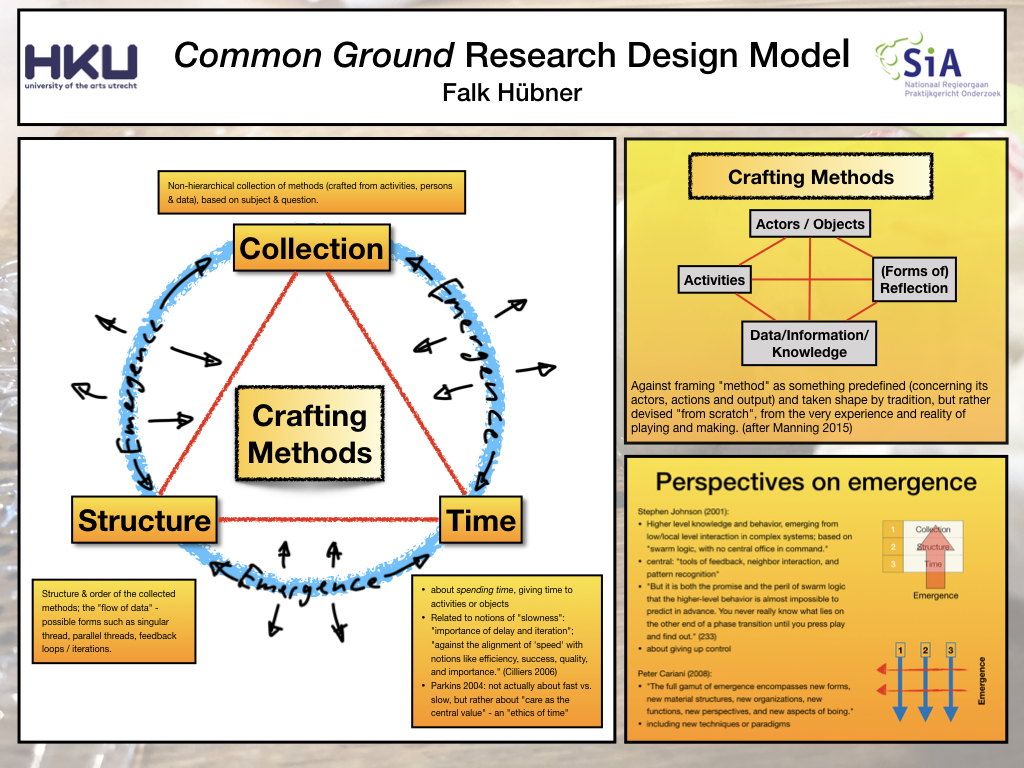
The two-year research project Common Ground explores different kinds of research methodology practiced at HKU University of the Arts Utrecht, conceptualize these into a coherent framework and develop this framework towards a new approach to designing research methodology within and related to the arts. The initial hypothesis of the project is that the quality of research processes, outcomes and impact at HKU, despite their already high quality, can be increased considerably through a more thorough and elaborated approach to research design.
Therefore, the research will start by collecting and mapping the various present approaches towards research across the entire HKU. This does not mean to unify of all these different approaches into just one way of doing research. The point is to develop a shared approach and vision towards the design process of research methodology, supported and inspired by the overall vision of HKU.
All activities of the project will involve a huge part of the network within HKU. As postdoc candidate I will lead this process, but will by no means work alone: I will collaborate closely with the Centre of Expertise for Research and Innovation, the professorships and the relevant teachers and research supervisors at the various schools.
The primary relevance and impact of the project is thus situated in the way research is conducted at HKU in the context of professorships, teacher-researchers and pre-PhD research; and the programmes of HKU itself, with regard to how teachers work with students on the methodology of their research. In summary, the project will impact both the practice as well as the pedagogy of research methodology. This goes for the context of HKU and on the wider field, the (inter)national discourse of research methodology in the arts.
The book: Between Solid Routes and Emergent Pathways
Between Solid Routes and Emergent Pathways offers a rich and innovative approach to method, research design and methodology of research in and through the arts. It spans the process from initial research design, ongoing and continuous decisions that need to be made while designing and carrying out research up to the analysis and reflection on this process when finished, including the philosophical considerations and groundings of the methodological decisions. Transdisciplinary in scope, this is not just a book “about”, but “to work with” methodology, supporting both seasoned and early career researchers, as well as supervisors in graduate, post graduate and doctoral education contexts.
Drawing on a huge body of experience, examples of renowned artist researchers in the international field, as well as on contemporary posthumanist and new materialist philosophy and methodological literature in the humanities and social sciences in particular, the conceptual core of the book is the author’s Common Ground model for research design: This model suggests a flexible approach both for the overall research design as well as for the from-scratch design of distinct methods. This means in particular to provide space for the unknown, and for the occasional messiness of research in and through the arts; the book provides a thorough exploration of the emergent aspects and unforeseen paths that come up during a research trajectory.
Different elements such as exercises or design questions, spread throughout the book, support the reader in order to literally work with its content and therefore learn not only through reading and digesting, but through applying the content to one’s own questions and research projects.
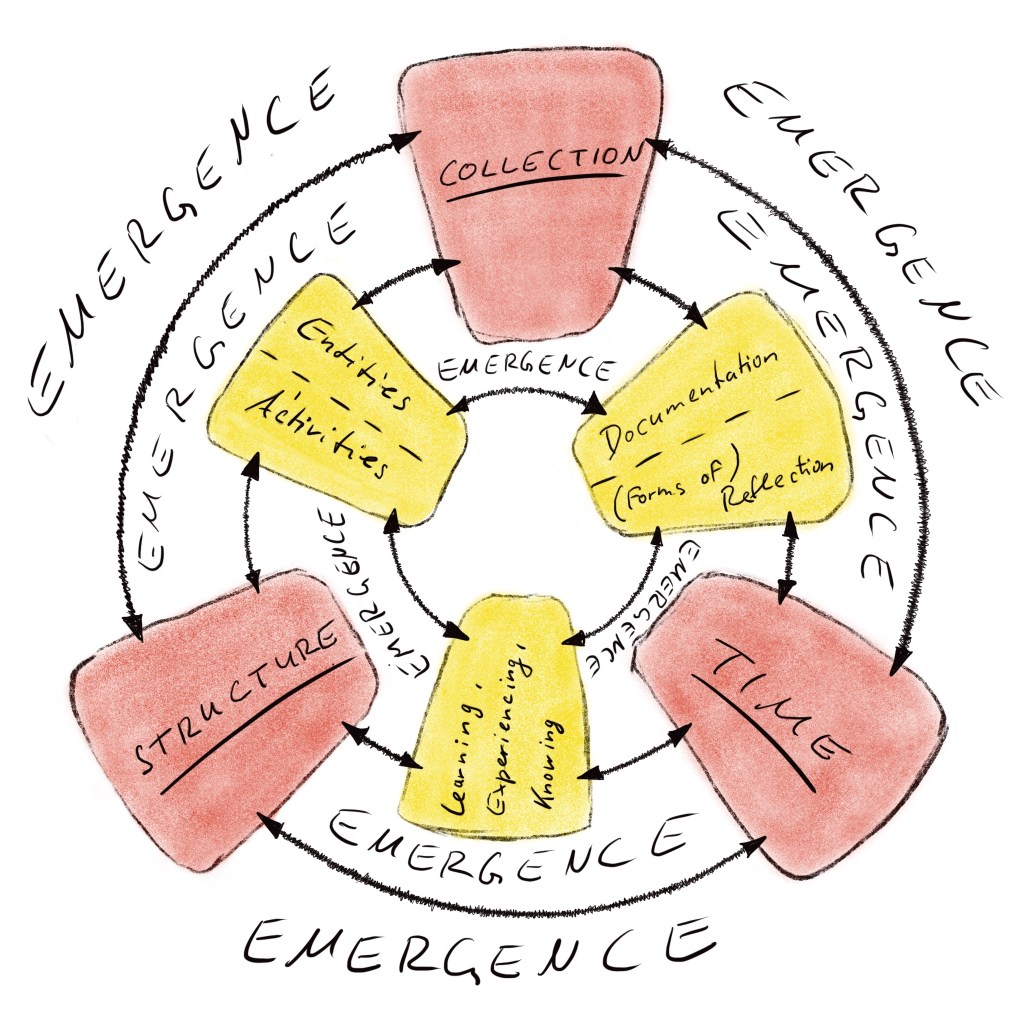
The Crafting Methods framework

A collection: Designing through questions
As mentioned several times throughout this book, the Common Ground model has been conceived and developed to serve as a flexible tool for the researcher and research at hand. The various perspectives and elements can be “accessed” not only through contemplating their characteristics and guidelines as nouns but also through activating them by asking questions.
As with the other elements aspects of the model, these questions can be used in both research practice and education. However, I think they work best as a flexible tool in supervision or peer feedback contexts. The biggest strength here – in my perspective – is that the supervisor or peer can ask questions to the student, group of students, researcher, or colleague without them needing to know the Common Ground model and its layers or how the model is conceived and works: the model as such does not need to be the topic of discussion; instead, it can be used as a framework or lens to look at the work, to navigate towards what the research project might need in a particular situation or phase, or to shed light on overlooked aspects of a research design.
I have compiled several lists of questions, which are grouped by topic and element of the Common Ground model. As most of the material offered in this book, they are meant to be worked and played with. Some questions do relate very explicitly to the elements of the Common Ground model, while others are more associative and exploratory. The reader is encouraged to use what is most helpful for their research project and the process of designing it. If some questions are too basic or irrelevant, simply leave them aside.
In general, I have avoided repeating questions that are already included in the chapters. So, please don’t consider this appendix as exhaustive, but feel invited to flip back and forth between the chapters’ contents and this appendix.
Supervising students and providing feedback to fellow researchers have led to this collection of questions. Some of these questions are edited versions, derived from several sources, literature, and various notes I made throughout the years. Where applicable, I have indicated (in parentheses) the sources the questions are based on, which are referenced at the end of this appendix.
Please keep in mind that these lists of questions are in ongoing process and development. I am editing and extending these series of questions as I continue using the questions and gain more experience and feedback from others.
Questions related to ethics
Have you thought about ethics in general? (2)
Would you consider your research as being conducted ethical? How can you ensure it is? (2)
To what extent are you responsibly fulfilling your role and obligations to participants, the topic, and all relations between them? (3)
Does your organisation or professional body have a code of ethics? Have you compared this to codes or guidelines for research ethics? (2)
Do your values conflict or resonate with your workplace or organisation? (2)
Are there any political, personal, or policy-related ethical issues at play? (2)
Are there any conflicts of interest? (2)
Can you mitigate possible harm? (2)
How can you explore your own position in and your impact on the environment? (2)
What might be the possible negative consequences for anyone participating in your research project?
In how far and to what degree do participants actually have the capacity to oversee all possible consequences and give fully informed consent?
Are you experienced (enough) in working with the kinds of participants you are planning to work with? (3)
Is the act of asking a question of a participant going to have an impact on that person? (2)
Regarding colleagues and/or other people, what can you do to make sure that you don’t use them – what’s in it for them?
Have you considered the “ethics of impact”? (2) How might your research and its activities impact those involved, both humans and non-humans (objects, places, materials, and networks)? (2)
Regarding self-care and self-support:
Are there any situations, contexts, or surroundings in which you might want or need to work in pairs rather than alone? (3)
If you are working in socially vulnerable contexts or surroundings or in participants’ homes, are colleagues or supervisors aware of where you are, and can you contact them easily? (3)
Regarding ethical reading and exploration of sources:
Do you always read background material attentively? Why? (3)
Do you draw on a narrow or a wide range of sources? Why? (3)
Is there anything you could do to make your reading practices more ethical? (3)
Can you think of any sources of information that should not be used to contextualise research? If so, what are they, and why shouldn’t they be used? (3)
Questions for ethical reflexivity:
What do you think about a certain situation? Why do you think that? (3)
How do you feel about this situation? Why do you feel that way? (3)
Have you taken into account your thoughts and feelings about all relevant theoretical, methodological, disciplinary, personal, or practical issues affecting the situation?
What impact could your thoughts and feelings have on your decision-making in this situation?
Who else is implicated in this situation? What might they think? How might they feel?
What impact could your decision-making have on them?
Should you make this decision alone or consult other people? If others, then whom? Why?
What kinds of biases might be in operation here? What impact could these have on your decision-making? What can you do to eventually minimise that impact? (3)
Questions regarding preparation
What is the goal of the research project?
To whom is this goal important and in which way? What will you get out of it? What will others take away from it? (1)
In which artistic and academic/theoretical/philosophical contexts is your research situated? Who are the artists, designers, educators, theorists, philosophers, thinkers, or others you feel drawn to or who inspire/inform your research project?
How are these contexts connected or related to each other?
Are you part of these contexts, or do you feel outside of them in one or another way?
What limitations do these contexts impose, and what opportunities do they offer? (2)
Has someone already worked on similar issues elsewhere? (2)
Can you find some insights from fields other than your own? (2)
Which limits and opportunities are there for the research project? Think in terms of time, means, ethics, or safety.
Concerning research results and outcomes:
What do you want to create during/with/through this research project? What constitutes findings?
What do you envision as outcomes and outputs of the research project? What will be left when the project itself is finished? (1)
What kind of change do you eventually want to realise during the research project?
What is not happening that you think should be happening? (2)
On what evidence do you base the need for change? (2)
How does it look/feel when the research project is successful?
Concerning dissemination and audience:
How will you share, make visible, and circulate the outcomes?
For whom are these relevant? (1) Who is/are your intended audience(s)? (2)
What should your research project offer to them – (what kind of) information, inspiration, knowledge, etc.?
What will convince them? What constitutes evidence? Will this evidence work differently for different audiences? (2)
What is your argument/evidence?
How do you ensure your research questions, process, practice, and outcomes are followable?
On conceptualising one’s own existing practice and the practices of the field:
What is (the core of) your (artistic/design/educational) practice?
How have you explained this practice to someone else? (2)
Which opportunities are there to develop your or others’ practice(s)?
How could mapping out the complexity of your practice (including in which contexts it is situated) help you? (2)
How do your values relate to the context(s) in which you work (most likely a workplace and/or organisation)? (2)
Questions Regarding Crafting Methods
Entities
Who needs to be involved and in what role(s)? Be specific and provide names rather than types of people. (1)
What other resources can help you? In which way? (1)
What functions might other-than-human entities have? Think of animals, plants, non-living objects or materials, spaces, surroundings.
On what basis do you choose the sources you look at/listen to (as you cannot include everything)? (2) What kinds of sources are you going to use – literature, other practitioners, documentation (still images, audio, video, transcripts, texts, live performances/improvisations, “here and now” situations, and so on)?
Can you get access to all the sources you need or would like to consult? (2)
Activities
What do you intend to do with the entities that you have identified? (2)
Which role does your own practice play? How do you incorporate your own practice in your method(s)? How does your own practice relate to the other activities?
In which way is your practice informed by other activities and sources, and in which way does it inform these? How might you want or need to change your practice and associated habits?
What are possible activities that people other than yourself might be carrying out in relation to your research? Are you the only one acting?
Documentation
What are the processes you like to document?
When do these processes happen? How do you make sure you will be able to capture these?
Which kinds of media or means (analogue as well as digital) are most suitable or effective for your documentation?
What kind of results or works do you imagine at the end of the entire research project? How might these be made transparent and followable by means of documentation?
Reflection
How will you evaluate the process and the outcomes of a distinct method?
What procedures or techniques of analysis (and/or reflection) will you use? Which modes, or forms of reflection, come to mind/might be appropriate? What methods of analysis or reflection are most appropriate or inspiring (you might use more than one, and experiment with them)?
How might reflecting on what happened affect your ideas, questions, or assumptions? In which way might you need to adjust what you thought you know?
Are you reflecting (mainly) on your own, or do you include others in the reflection on a particular activity?
Learning, experiencing, knowing
What kind of information or data are you looking for?
What kinds/modes of knowledge do you seek to find or generate?
Do your ideas for the outcomes of a method align with your envisioned set of entities, activities, documentation, and reflection? If not, what are possible adjustments (hint: experiment)?
On Collection
Which persons and materials (and their functions, identities) come to mind when you think about your research project in general and your research questions in particular?
What kind of information, data, or experiences are you looking for? What kinds/modes of knowledge do you seek to find or generate?
Who needs to be involved and in what role(s)? Be specific and provide names rather than types of people. This is also material to be used when you start crafting your methods. (1)
What other resources can help you? In which way? (1)
Which research methods or activities can be used that would help to build respectful relationships between you as artist-researcher and eventual research participants? (3)
What kinds of sources are you going to use – literature, other practitioners, artistic works, documentation (still images, audio, video, transcripts, texts, live performances/improvisation, “here and now” situations, and so on)?
On Structure
How is the “flow of data” or “flow of knowledge” progressing throughout your project? What comes first, what next? Which steps, activities, or methods need to take place in order to proceed?
Which pieces of information or experience do you need in order to proceed? Think about different types of modes or data: for example, you might need to carry out a certain experiment in practice in order to frame your theoretical references or field.
Do you consider any of the methods you tend to employ more important than the others? Are there any priorities or hierarchies?
Which activity would you want to carry out more than once? Where would you like (or need) to return to again?
Through which form might the different activities be connected?
Are you including any (feedback) loops or iterations?
On Time
Where and when can/will the research project and its activities take place? (1)
How much time do you want to spend with the various activities?
If there are activities or methods involved that occur more than once (think of iterations or cycles/series of experiments), do you want to give them the same amount of time (and attention) each instance, or is there a difference in terms of time (and attention)?
With whom or what (entities or activities) do you want to spend time in order to explore and inquire into your research questions?
What kind of a timeline results from your considerations about spending time when you take on a purely content-related perspective?
How does this timeline relate to how much time you actually and formally have for the research project?
On Emergence
What are possible events or developments that you cannot foresee? Can you speculate?
Can you imagine anything that you might discover but cannot yet fully conceptualise?
How do you provide space for what emerges?
In which ways are you paying attention to what emerges?
Is this providing space a conscious (design) decision? Is there any part of your research design that facilitates lower-level interaction (e.g., discussion between participants or collaborators, feedback sessions, or experimentation series) in such a way that something unexpected can emerge?
Does this concern specific moments in your research or long-term processes?
When might you want to provoke emergence or anything that you cannot foresee or predict? When are you consciously looking for the unexpected?
In hindsight: How have you managed the unanticipated, and how will you prepare for the unexpected next time? (4) How can you rethink and rework your approach towards the unexpected?
Who are you asking for feedback, and what forms of feedback are you inviting? (4)
What is guiding the way you receive, process, and act on feedback? (4)
What connections can be drawn between causes and effects? (4)
What guidelines or larger principles can be drawn from particular instances of practice? (4)
Sources:
1: Gaunt, Helena and Rosmalen, Bart van (2013). “Planning and realising a collaborative project” [unpublished work sheet provided at the Innovative Conservatoire (ICON) 2013 seminar, “Craft of Collaboration”].
2: Costley and Fulton 2019, pp. 73-74.
3: Kara 2018, pp. 26, 82, 94, 163.
4: Haseman and Mafe 2010, p. 225.
 Falk Hübner